Voyager (Obsidian Plugin)
System Modules
Voyager AI: Semantic Knowledge Management for Obsidian
Project Overview
Voyager AI is an Obsidian plugin that brings advanced semantic search and AI-powered knowledge retrieval to personal knowledge management. Built to solve real-world challenges in academic note-taking, Voyager leverages vector embeddings and Retrieval-Augmented Generation (RAG) to help users find and connect information across their knowledge base without relying on exact keyword matches or rigid organizational structures.
The Problem
As an engineering student maintaining extensive notes in Obsidian, I frequently encountered a frustrating workflow bottleneck: finding existing notes on topics I'd already documented. The core challenge manifested in two distinct scenarios. During lectures, I would sometimes create duplicate notes on the same topic because I couldn't quickly locate the relevant existing document. When working on homework assignments, I knew I had notes on specific concepts somewhere in my vault, but traditional search methods required remembering exact titles or keywords—a significant cognitive overhead when trying to focus on problem-solving.
This wasn't simply a matter of poor organization. Even with a well-structured vault, the rigid taxonomies and folder hierarchies that work well for some knowledge domains break down when dealing with interconnected engineering concepts that span multiple courses, projects, and contexts. What I needed was a way to find notes based on semantic similarity—on what the content means rather than what it's called.
Technical Implementation
Voyager represents my first deep dive into the modern AI/ML stack, specifically vector embeddings, semantic search, and RAG architectures. For this initial project, I opted for proven, cloud-hosted solutions that would allow me to focus on the core functionality rather than infrastructure management.
The architecture centers on three key components:
Vector Database: I selected Qdrant as the cloud-hosted vector store, providing scalable storage and efficient similarity search for document embeddings. Qdrant's API and performance characteristics made it well-suited for the real-time search requirements of an Obsidian plugin.
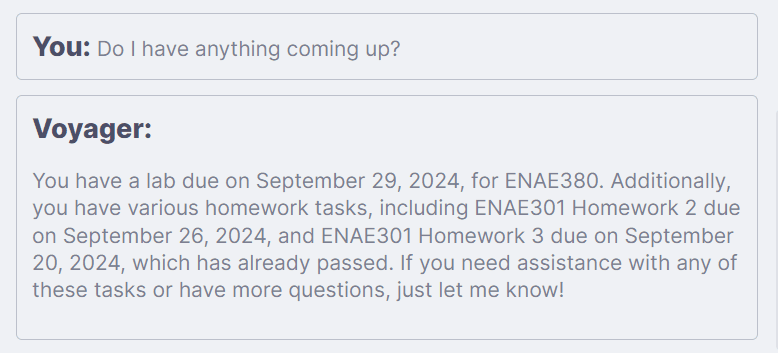
Embedding and Language Models: The OpenAI API powers both the embedding generation (for converting notes into vector representations) and the conversational RAG interface. Using OpenAI's models provided state-of-the-art semantic understanding while allowing rapid prototyping.
Obsidian Plugin Framework: The most challenging technical aspect was learning the Obsidian plugin development ecosystem from scratch. This involved understanding the plugin API, lifecycle management, event handling, and UI integration patterns specific to Obsidian's architecture.
One of the most complex engineering challenges was implementing efficient synchronization between the Obsidian vault and the vector database. The system needed to track which documents had changed and re-index only those files, avoiding unnecessary API calls and maintaining consistency across the knowledge base. This required building a metadata tracking system that could detect modifications, handle edge cases like file renames and deletions, and maintain sync state reliably.
User Workflows
Voyager supports two primary workflows that directly address the original problems:
Lecture Note Integration: While taking notes during a lecture, all content goes into a single working document. Voyager's similarity search sidebar displays existing notes with semantically similar content in real-time. This immediate feedback makes it trivial to identify whether to update an existing note or create a new one, eliminating the duplicate note problem entirely.
Homework Research: When encountering a concept during homework that requires reference material, semantic search allows finding relevant notes based on conceptual similarity rather than exact title matching. Searching for "heat transfer in fluids" might surface notes titled "Convection Analysis" or "Thermal Dynamics Lab 3"—connections that keyword search would miss.
Impact and Evolution
While Voyager is no longer actively maintained, it served its purpose during my academic work and, more importantly, provided foundational knowledge that proved crucial to my professional development. The hands-on experience with retrieval pipelines, vector embeddings, and RAG architectures gave me practical understanding of concepts that have become central to modern AI systems.
This groundwork directly informed my current work leading AI transformation initiatives at Aegis Project Controls, where I've deployed enterprise LLM systems, built custom Model Context Protocol (MCP) servers, and implemented sophisticated agentic workflows. The retrieval and indexing patterns I learned building Voyager translate directly to production RAG systems, agent architectures, and knowledge management at scale.
Key Takeaways
Voyager demonstrates several important technical capabilities:
Practical AI Application: The project shows an ability to identify real problems and implement working AI solutions, not just theoretical understanding. The focus on user workflow and actual usability distinguishes this from purely academic exercises.
Full-Stack Development: Building an Obsidian plugin required end-to-end ownership—from cloud infrastructure and API integration to UI/UX within the Obsidian environment. This encompasses backend services, client-side development, and user interface design.
System Design: The synchronization challenge required thinking through data consistency, performance optimization, and edge case handling—skills that apply broadly to distributed systems and real-time applications.
Foundation for Advanced Work: Perhaps most significantly, Voyager provided the conceptual foundation for understanding modern agentic AI systems. The retrieval patterns, embedding strategies, and RAG architectures learned here scale directly to enterprise applications and advanced agent frameworks.
The shift away from maintaining Voyager reflects natural project evolution and changing priorities as I moved from academic work to professional software development. However, the technical knowledge and practical experience gained from building it continue to inform sophisticated AI systems work today, making it a valuable stepping stone in my development journey.